Forget everything you know about those limp, sulfurous florets that haunt the back of cafeteria steam tables. We are not here to boil the life out of our crucifers; we are here to engineer a neuroprotective powerhouse. When you slice into a fresh head of broccoli, you are initiating a high-stakes chemical reaction. You are activating myrosinase, the enzyme responsible for converting glucoraphanin into the legendary Broccoli Sulforaphane. This molecule is the gold standard of phytochemicals; it is a potent Nrf2 inducer that triggers your body's own antioxidant defense systems. To capture this volatile compound, we must treat the kitchen like a laboratory. We need precision, thermal control, and a deep respect for the cellular integrity of the plant. If you overcook it, the enzyme dies, and your health benefits vanish into the steam. If you undercook it, the fibrous stalks remain indigestible. We are aiming for that perfect, vibrant emerald green that signals peak bioavailability and a crisp, snappy texture that sings on the palate.
THE DATA MATRIX
| Metric | Specification |
|---|---|
| Prep Time | 10 Minutes |
| Execution Time | 5 Minutes |
| Yield | 4 Servings |
| Complexity (1-10) | 3 |
| Estimated Cost per Serving | $0.85 |
THE GATHERS
Ingredient Protocol:
- 500g / 1.1 lbs Fresh Broccoli Crowns (tightly packed florets)
- 15ml / 1 tbsp Extra Virgin Olive Oil (high polyphenol count)
- 5g / 1 tsp Flaky Sea Salt
- 2g / 0.5 tsp Red Pepper Flakes (to infuse heat)
- 1/2 Lemon (for bright acidity)
- 1g / 0.25 tsp Mustard Seed Powder (essential for Broccoli Sulforaphane reactivation)
Section A: Ingredient Quality Audit:
The most common failure point is starting with "zombie" broccoli. If the stems are woody or the florets are beginning to yellow, the glucosinolate content has already begun to plummet. If your broccoli feels rubbery, it has lost turgor pressure. To fix this, submerge the stalks in an ice-water bath for fifteen minutes before cutting; this allows the cells to rehydrate through osmosis. Furthermore, if you are using pre-cut bagged broccoli, the myrosinase may be degraded. The technical fix is the addition of mustard seed powder. Because mustard is a crucifer, its active enzymes will bridge the gap and ensure the conversion of Broccoli Sulforaphane even if the broccoli's own enzymes were damaged by heat or age.
THE MASTERCLASS
Step 1: The Precision Dissection
Using a sharp chef knife or a dedicated bench scraper to clear your station, divide the broccoli into uniform bite-sized florets. Do not discard the stems. Peel the fibrous outer layer of the stalk to reveal the tender, pale green marrow. Slice these into thin coins.
Pro Tip: Uniformity is the soul of consistency. If your florets vary in size, the small ones will turn to mush before the large ones reach the ideal al dente state. Use a digital scale to ensure your batches are weighted equally for even steam distribution.
Step 2: The Myrosinase Activation Gap
Once cut, let the broccoli sit on your cutting board for at least 40 minutes before introducing heat. This is the "hack and hold" method. It allows the enzymes maximum time to generate Broccoli Sulforaphane before they are potentially neutralized by the steaming process.
Pro Tip: This enzymatic reaction is a mechanical defense mechanism. By damaging the cell walls with your knife and then waiting, you are essentially "pre-digesting" the compounds into their most bioactive forms.
Step 3: Controlled Vapor Saturation
Bring 5cm / 2 inches of filtered water to a rolling boil in a saucier or deep pot fitted with a steamer basket. Place the broccoli in the basket, cover with a tight-fitting lid, and set your timer for exactly four minutes.
Pro Tip: Do not let the water touch the vegetables. We are using the latent heat of steam, not boiling. Boiling causes water-soluble vitamins and the very compounds we want to save to leach into the water and go down the drain.
Step 4: The Thermal Shock
Immediately remove the basket when the timer hits. The broccoli should be a glowing, neon green. If you are not serving immediately, plunge the florets into an ice bath to render the cooking process inert. If serving now, toss in a stainless steel mixing bowl with the olive oil and mustard powder.
Pro Tip: The mustard powder acts as a catalyst. Even if some myrosinase was deactivated during the four-minute steam, the mustard powder provides a fresh dose of the enzyme to ensure the Broccoli Sulforaphane is fully bioavailable upon ingestion.
Section B: Prep & Timing Fault-Lines:
The greatest risk in this protocol is the "carry-over" cook. If you leave the broccoli in the hot steamer basket with the heat turned off, the internal temperature will continue to rise. This results in the breakdown of chlorophyll into pheophytin, turning your vibrant green into a dull, unappetizing olive drab. Always use a digital timer. If you are multitasking, set an alarm that requires physical movement to turn off so you do not miss the window of perfection.
THE VISUAL SPECTRUM
Section C: Thermal & Visual Troubleshooting:
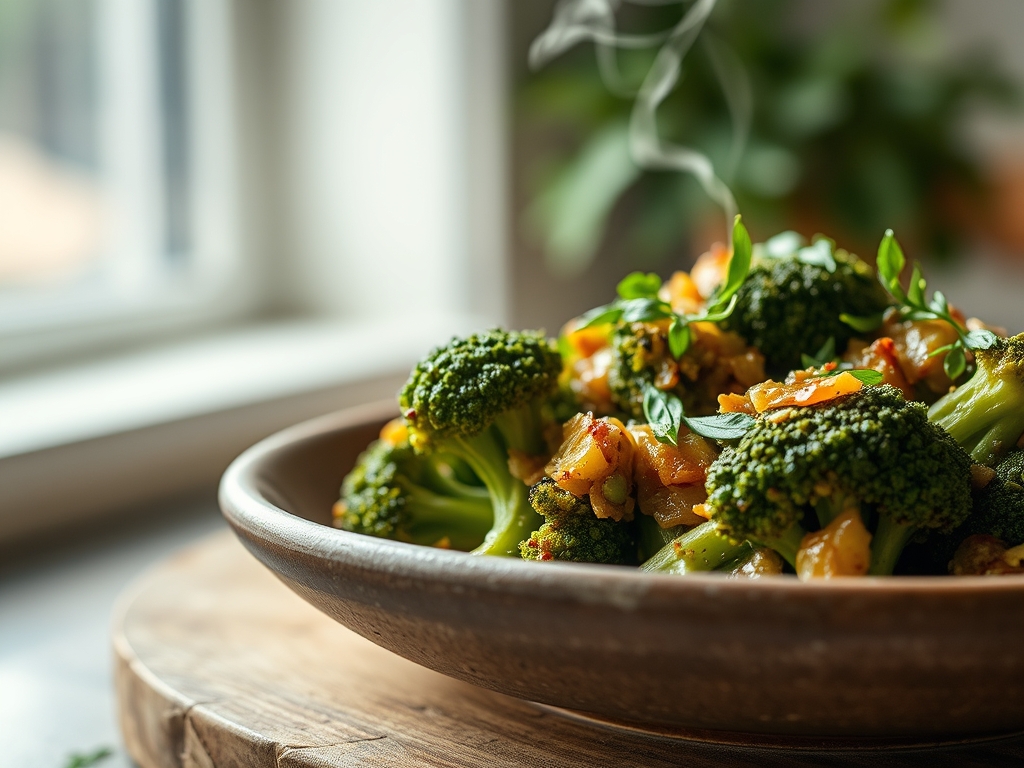
Look closely at the Masterclass photo above. Notice the "beading" of moisture on the florets and the lack of any brown or yellow edges. This is the visual benchmark. If your broccoli looks "shriveled," you have steamed it at too high a temperature for too long, causing the cell walls to collapse entirely. If the color is uneven, your steamer basket was likely overcrowded, preventing the steam from circulating around each floret. Ensure you only fill the basket two-thirds full to allow the vapor to aerate the spaces between the branches. If the stalks are white and the tops are dark, you didn't trim the stalks thin enough; remember that density dictates cook time.
THE DEEP DIVE
Macro Nutrition Profile:
A standard 150g serving provides approximately 55 calories, 4g of protein, 0.5g of fat (pre-oil), and 5g of fiber. It is a dense source of Vitamin K and Vitamin C.
Dietary Swaps:
- Vegan: This protocol is inherently vegan. Enhance the umami by adding a nutritional yeast dusting.
- Keto: Increase the healthy fats by swapping olive oil for grass-fed butter or ghee.
- GF: Naturally gluten-free. Ensure your mustard powder has no wheat-based anti-caking agents.
Meal Prep & Reheating Science:
To maintain the molecular structure during meal prep, under-steam the broccoli by 60 seconds. When reheating, avoid the microwave if possible; it creates "hot spots" that destroy delicate antioxidants. Instead, flash-saute in a pan with a tablespoon of water to deglaze the surface and gently bring it back to temperature.
THE KITCHEN TABLE
Why does my broccoli smell like sulfur?
That scent is the result of overcooking, which breaks down sulfur-containing amino acids. If you smell it, you have gone too far. Stick to the four-minute rule to keep the scent fresh and piquant.
Can I use frozen broccoli?
Frozen broccoli is usually blanched before freezing, which deactivates the myrosinase. You must add mustard seed powder to frozen broccoli after heating to ensure you are getting any Broccoli Sulforaphane benefits.
Is the stem actually healthy?
Absolutely. The stem contains nearly identical nutrient profiles to the florets but offers a different fiber structure. Peeling the "skin" is the secret to making them taste as luxurious as a water chestnut.
Do I need a fancy steamer?
No. A simple bamboo basket or a stainless steel fold-out insert works perfectly. The key is the seal of the lid and the timing, not the price tag of the hardware.
Why add lemon at the end?
The ascorbic acid in lemon juice not only brightens the flavor but also aids in the absorption of certain minerals found in the broccoli. It is a functional and culinary win.